Connect ChatGPT
Connect the ChatGPT desktop app or ChatGPT on the web to your site with one connection link.
On this page
ChatGPT connects to your site with a connection link: one address that already carries its own key. In the ChatGPT desktop app you paste it as an MCP server. On chatgpt.com you paste it as a custom connector in developer mode. Signing in to your site instead of using a link is still possible.

Before you start
- You need a WordPress account that may use AI. By default only administrators can. See Server settings.
- The desktop app connects from your computer, so it also works with a site that runs on your own machine. On a public site the link needs HTTPS.
- ChatGPT on the web connects from OpenAI's servers, so your site must be public and use HTTPS, and your plan must include developer mode.
ChatGPT desktop app
Create a connection link
Go to Uncoder → AI & MCP → Connect a client, choose ChatGPT, and on the Desktop app tab click Create connection link. Click Copy. The link is shown only once.
Add the server in ChatGPT
In the ChatGPT desktop app, open Settings → Plugins → MCPs and click Add → Add MCP server. In some versions the menu is Settings → MCP servers → Add server.
Paste the link
Enter a short Name such as
uncoder, choose Streamable HTTP as the Type and paste the link into URL. Leave every other field empty. Click Save.Try it
In a chat, ask something like: "List my pages and write an SEO title and meta description for each one."
The ChatGPT desktop app shares its MCP servers with the Codex CLI, so the same link works there: codex mcp add uncoder --url "<your link>".
Leave Bearer token env var empty. That field takes the name of an environment variable, not a key. A key pasted there is ignored, and ChatGPT connects without credentials, so every request fails with "Authentication required".
ChatGPT on the web
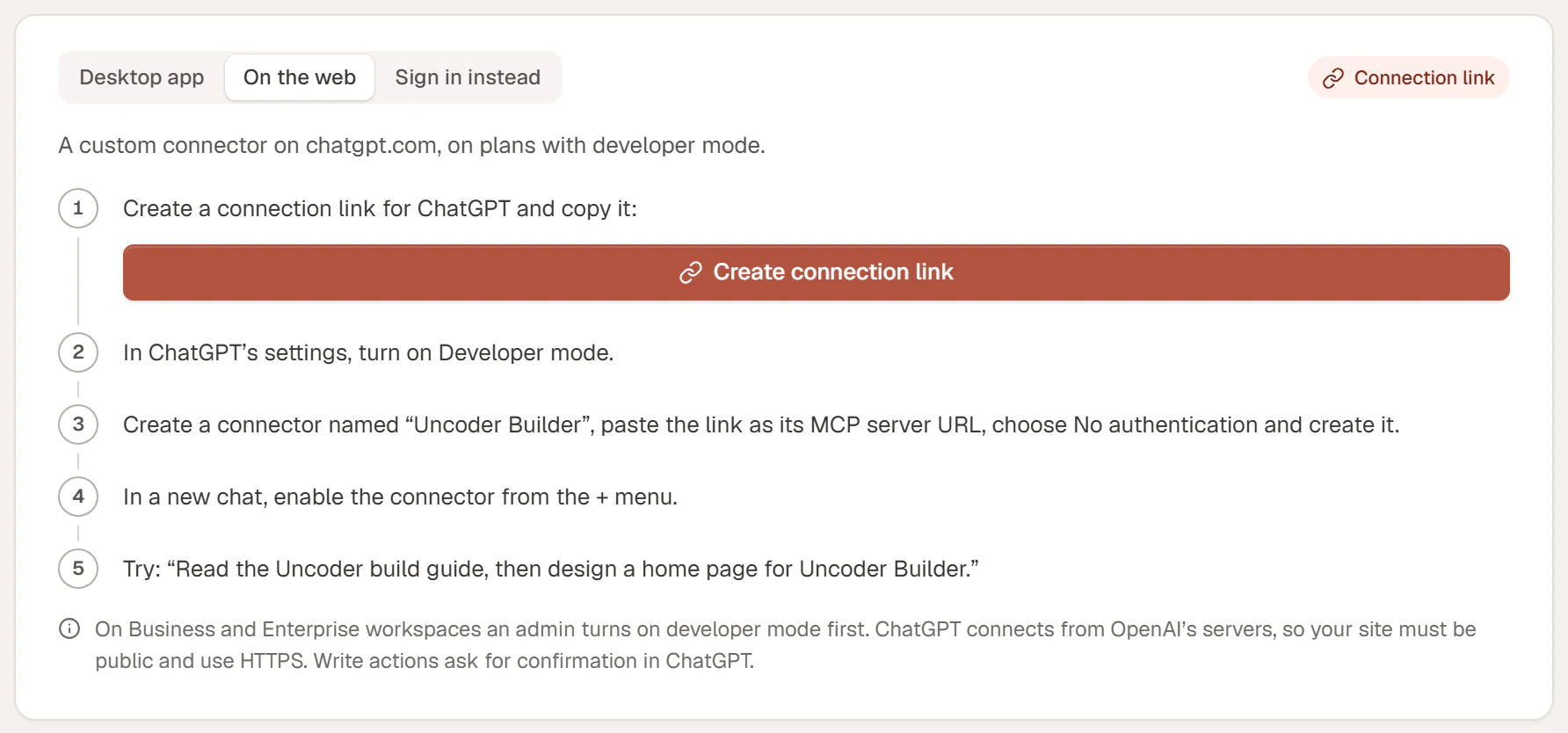
Create a connection link
On the On the web tab, click Create connection link and copy the link.
Turn on developer mode
On chatgpt.com, open Settings → Apps & Connectors → Advanced settings and turn on Developer mode. On Business and Enterprise workspaces, an admin allows developer mode first.
Create the connector
Back in Apps & Connectors, click Create. Enter your site's name, paste the link as the MCP server URL and choose No authentication. Confirm that you trust the connector and click Create.
Use it in a chat
In a new chat, open the + menu, choose Developer mode and enable your site's connector.
A connection link gets the Read, Content and Design permissions: ChatGPT can read, create and edit pages, posts, media and the design, but not change site settings. Keep it private, like a password, and revoke it under API keys if it was shared by mistake. See Connection links.
Sign in instead
Prefer no key in an address? ChatGPT can sign in to your site instead (OAuth). Your browser opens your site, you log in, check the permissions and click Approve.
- Desktop app: add the server with the plain Server URL from the Sign in instead tab (no link at the end), choose Streamable HTTP, leave every other field empty and click Save. Sign in when ChatGPT asks, or run
codex mcp login uncoderin a terminal. - On the web: create the connector with the same Server URL and choose OAuth as the authentication. This needs a public HTTPS site.
The permissions screen is the same for every app that signs in. Read is always included, Content and Design are checked, and Site is unchecked unless you tick it. See The approval screen. After you approve, ChatGPT appears under AI & MCP → Connected apps.
Confirmations in ChatGPT
Tools that change your site ask for your confirmation in ChatGPT before they run. Read what ChatGPT is about to do, then allow or deny it. Uncoder marks each tool as read-only or as making changes, so ChatGPT knows which ones need a confirmation.
This is separate from Uncoder's own safety net: every change is still logged in Activity, and changes to pages, templates and the Design System can be undone there.
If it does not connect
- "Authentication required" in the desktop app: the server was saved with something in Bearer token env var, or without a link. Edit the server, clear that field, paste the connection link as the URL and save.
- "This site is not reachable from the internet" on the On the web tab means Uncoder detected a local address. chatgpt.com cannot reach it: use the desktop app, put the site online, or use a tunnel service for testing.
- "Connection links work only over HTTPS": turn on SSL for your site.
- The sign-in window shows "Can't connect this application": read the message under it. The most common one is that your account's role is not allowed to use AI. An administrator can allow it in Server settings.
More fixes: Troubleshooting.